From 10 Years of Growth to the Defining Fire Season of 2026
Posted 18 February 2026
1) When preparation meets reality
On 3 January 2026, we reflected on a decade of building a community-driven emergency-response capability in Drakenstein—one shaped by necessity, governance, and the simple truth that minutes decide survival in rural fire environments.
Only weeks later, that reflection was tested in the harshest way imaginable.
The 2026 fire season has already become one of the most demanding ever experienced in the valley.
What followed was not planning or projection—but continuous real-world deployment under extreme pressure.
And yet, despite the scale, intensity, and financial strain: DFW stood its ground.
Lives, heritage, farms, and homes were saved.
And the model of private professional fire response—combined with humanitarian service—proved its worth beyond doubt.
2) A decade of preparation made visible in weeks
Over the past 10 years, DFW evolved from a civilian volunteer initiative into a fully governed emergency-response organization, operating across roughly 1,500 km² with:
A dedicated radio control room and activation network
Operational fleet, workshop, repair capability, and fire engine hall
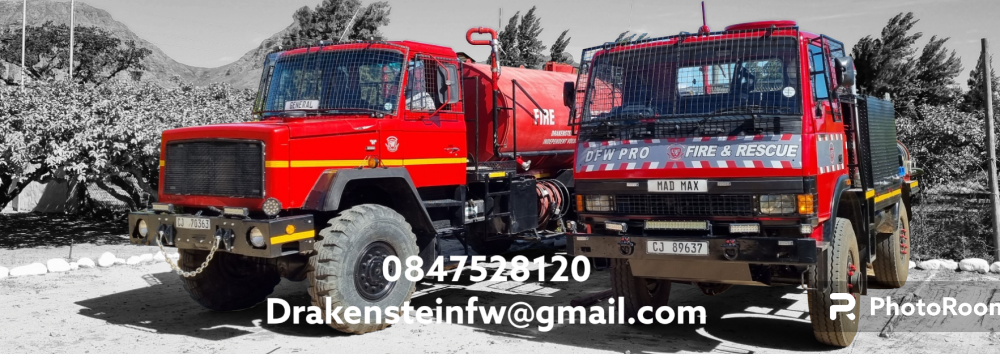
Engineered firefighting assets, including tanker-pumper deployment and locally developed CAFS/UHP protection systems
A governance structure separating mandated professional fire response from pro-bono humanitarian, medical, disaster-relief, and training work
This separation—often misunderstood—is what keeps our response organization alive, compliant, and financially sustainable.
January and February 2026 proved why this structure matters.
3) The fire season that tested everything
Never before has the region seen so many ignitions, extended incidents, and multi-day fire threats in such a short period.
Since the start of January alone, DFW has participated in 36 major fire incidents, some alongside partners, others entirely alone.
Among the properties and historic farms where DFW intervention helped prevent total loss:
Boschendal, La Paris, Roggeland, La Pareille, Avondale, Helderstroom, Hartebeeskraal, De Hoop, Afsaal, Wilde Paardejacht, Corcheval, Otterkuil, Morelig,Welgegund, Ebenezer and
Salomonsvlei —and numerous additional veld and structural threats across the valley.
Several of these incidents:
Lasted multiple days, Spread rapidly under wind and lightning conditions,
Threatened historic thatch-roof heritage buildings, Required heavy tanker-pumper deployment and CAFS structural protection
In many cases, outcome—not just response—was determined by speed, foam protection capability, and sustained presence on scene.
4) Proven capability under extreme cost
Throughout this relentless season, DFW demonstrated:
Operational endurance across consecutive incidents
Effective use of privately engineered CAFS systems for thatch and heritage protection
Deployment of large tanker-pumper trucks where water logistics determined survival
Determination to act as guardians of the valley—even when resources were stretched
But success came at a price: Severe fleet wear and mechanical breakdowns,
Loss and damage to equipment and materials, Escalating fuel, maintenance, and compliance costs, Continuous demand on crews, volunteers, and command capacity
The DFW endured—supported by insurers, donors, and sponsors—but the season has made one truth unmistakably clear:
Sustained protection of Drakenstein now requires expanded water-carrying capacity.
5) Legal clarity meets operational reality
Recent High Court clarity (December 2025) confirmed that:
Private contracted firefighting is lawful
Volunteer and community assistance is not prohibited
Municipal authority must still be respected
DFW already operates precisely within this framework:
Professional mandated fire response
+
Humanitarian community protection
The law now recognizes what the fire season has demonstrated in practice:
Private readiness is no longer optional—it is essential.
6) Why expansion cannot wait
Extreme weather, rising ignition frequency, and stretched public resources mean:
Demand is increasing faster than response capacity. At the same time, a second and even more critical risk is emerging:
Water scarcity.
Many rural fire zones: Have no functional hydrants, Depend on limited farm dams or seasonal sources, Face declining water levels as summer progresses.
In extended incidents, water availability—not manpower—becomes the deciding factor between containment and total loss.
7) The urgent operational priority — a Major 6×6 Fire Tanker
To protect Drakenstein against escalating large-scale fires and diminishing water access, DFW now faces a single, critical priority:
Acquisition of an additional Major Water Tanker
Required capability: 6×6 all-terrain fire truck, ± 8,000-litre on-board water capacity
Designed for rural access, veld interface, and extended fire-ground supply
Able to sustain multi-hour structural and wildfire defence where no hydrants or refill points exist.
This vehicle is not a luxury. It is the difference between fighting fire—and running out of water while it advances.
Funding requirement: R 2.9 million
DFW therefore calls on the regional business community, agricultural sector, insurers, and partners to help secure this life-protecting capability before the next severe incident arrives.
Because as water resources diminish, the need for this tanker will become undeniable—very soon.
8) A final call before the financial year closes
As the financial year end approaches for many companies, an immediate opportunity exists to support real, proven protection: DFW is a:
Registered Non-Profit Company and a SARS-approved Public Benefit Organization
Able to issue income-tax-deductible donation certificates (Section 18A where applicable)
This means:
Supporting DFW can effectively be funded through tax already payable—
strengthening regional safety, without increasing net expenditure.
The fire season is not yet over.
Further disasters remain possible.
What happens next depends on who stands with readiness before the next ignition.
9) Partnership, not charity
If you: Own property, Farm the valley, Insure assets, Employ people, Invest in Drakenstein’s future?
Then DFW already protects what matters to you. We ask you to come on board:
Not as charity.
As partnership.
As shared responsibility.
As practical protection of lives, heritage, and economic stability.
Compliance & Donation Details
DFW Fire & Rescue NPC
PBO Number: 930062323
CIPC: 2017/344314/08
Bank: Nedbank
Branch Code: 102905
Account Name: DFW
Account Number: 1152188429
Email: drakensteinfw@gmail.com
Office: Sonstraal Road 1, Paarl, Western Cape
Tel: 084 752 8120
Tax certificates available on request.
 DFW FIRE & RESCUE NPC