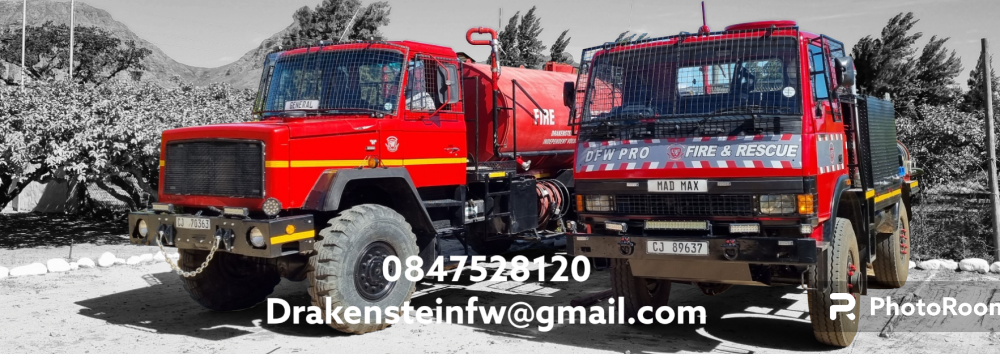
Oversight report + urgent request for 2 additional response vehicles (Supercab units)
1) Why this matters now
In the rural corridors and farm valleys of Drakenstein, fire has become the fastest “weapon” of destruction—not because people choose it, but because the environment, the pace of incidents, and the strain on public capacity mean minutes decide whether a farm or housing communities survive, people get spared or another historic legacy disappears.
Over the past 10 years, what began as a civilian, community-driven initiative by rightfully concerned residents has evolved into a fully governed, operationally disciplined emergency-response organization: DFW Fire & Rescue NPC, serving an area of roughly 1,500 km², with structured leadership, a board of directors, and a growing network of businesses and properties connected through written mandates.
The result is a capability that is rare in South Africa’s rural environment:
- A private radio control room + WhatsApp Activation Network
- A functional office, shop, workshop, repair capability, and fire engine hall
- Engineered firefighting assets (including pump-and-drive capability and CAFS/UHP capacity for high-risk structural protection)
- A governance model that separates mandated private fire response from pro-bono humanitarian, disaster relief, education, and medical support
This separation is not a “nice-to-have.” It is the only way to keep a response entity alive without collapsing financially.
2) From “good Samaritans” to a structured, scalable response model
In the early years, DFW relied heavily on volunteers who responded in their own vehicles—often fitted with temporary skid units, radios, and equipment. It was brave, and it worked—until reality caught up:
- Red tape, liability exposure, and insurance complexity increased
- Volunteers absorbed escalating personal costs: fuel, tyre damage, vehicle dents, broken windows, and mechanical wear
- Risk and compliance pressures made the “bring-your-own-vehicle” model harder to sustain safely and consistently
So DFW did what serious emergency services must do: it professionalized.
Not to replace community spirit—but to protect it and make it sustainable.
Since 2017, DFW deliberately expanded a professional, properly equipped response capacity, using vehicles owned and maintained under the organization, operated under strict operational policy and governance—because readiness costs money even when there is no fire.
3) The two-lane mandate: professional fire response + pro-bono community service
DFW’s model has matured into two distinct, equally important pillars:
A) Mandated Fire Response (cost-recovery / sustainability lane)
Fire response requires a workshop, mechanics, a maintained fleet, trained crews, PPE, radios, insurance, and operational deployment costs. Those costs cannot be covered by membership fees alone—especially when incidents surge.
B) Pro-bono Medical, Humanitarian Aid, Disaster Relief & Training (upliftment lane)
DFW’s medical assistance, humanitarian relief, disaster response support, and education/training programs (fire + medical) have been delivered pro-bono, mostly through volunteers, with extra costs covered through donations.
This dual approach is exactly the type of community safety model South Africa needs more of: a sustainable engine that funds readiness, and a compassionate arm that serves beyond the client base.
4) Legal clarity: the environment has changed
In December 2025, a Pretoria High Court decision in the Tshwane matter provided significant clarity for private and volunteer firefighting models. Reporting on the case reflects that the court rejected the attempt to have private firefighting services declared unlawful, and found that contracted private firefighting and volunteer association assistance are not prohibited by legislation, while emphasizing that private responders must not interfere with the statutory powers of municipal fire services.
This matters because DFW operates on both angles the judgment speaks to:
- Private firefighting to contracted/mandated clients
- Volunteer/community assistance where municipal capacity is thin
That clarity removes some uncertainty—but it does not remove the cost burden of being ready, trained, equipped, and properly protected.
5) Proof of impact: when the fire wins elsewhere, preparation still saves lives and heritage
A single incident can explain the difference between “response” and “outcome.”
During the devastating fire at Laborie on 20 December 2025, reports describe multiple buildings being severely affected.
Against conditions where a fierce fire spread overwhelmed local resources, DFW’s on-site capability to stop ignition on adjacent thatch roofing and to apply protective foam cover (CAFS) to withstand ember assault demonstrated what modern private response can achieve: damage reduction, asset preservation, and incident containment—especially on high-risk heritage and structural environments.
This is exactly why insurers increasingly pay attention to fast, competent private response: it doesn’t just “fight fire”—it cuts the claim size and prevents total loss.
6) The operational reality: readiness is expensive, and demand is rising
DFW’s fire season activity is escalating. With extreme weather conditions, December alone saw more than 200 combined responses involving DFW and the local fire brigade (as tracked internally). The next months remain high-risk.
At the same time, every year the cost base grows:
- PPE replacement and compliance
- Training and competency maintenance
- Fleet wear, pumps, tyres, radios, fuel
- Insurance, administration, governance, and staffing
- Workshop capability (the backbone of readiness)
This is why DFW must expand now—not later.
7) The urgent request: 2 additional Supercab response vehicles
DFW urgently needs two additional response vehicles to keep up with demand and maintain response integrity across the area:
Vehicle 1 — Professional Fire Response Expansion Unit
Purpose: strengthen the mandated private-response lane with rapid first response, structural protection capability, and high-reliability deployment.
Typical capability role (configuration varies by final build):
- Full radio integration (control room + operational channel)
- Rapid-deploy hose, fittings, nozzles, foam capability where required
- Equipment carriage for structural and veld interface response
- Crew transport + scene support function
Vehicle 2 — Pro-bono / Community & Disaster Support Unit
Purpose: expand the humanitarian/medical/disaster support lane without weakening the professional fire fleet—so community service doesn’t become a financial or operational threat to core readiness.
Typical capability role:
- Medical and rescue support carriage (scope aligned with training level)
- Community response support, disaster relief logistics
- Fire awareness / training equipment transport
- Rapid responder mobility for informal settlement and rural incidents
In plain terms: these vehicles allow DFW to arrive faster, stay longer, and cover more ground, without burning out the same small core of responders.
8) How the business world and public can help (practical sponsorship options)
DFW is calling on business leaders, farms, estates, insurers, manufacturers, and the public to stand behind a proven response capability.
Sponsorship routes
- Sponsor a full vehicle (branding + public acknowledgement + reporting pack)
- Sponsor a build component (radio fitment, tyres, fuel allocation, PPE set, pump/hoseline package)
- Monthly readiness pledges (keeps the wheels turning when there is no fire—this is what saves the next building)
- In-kind sponsorships (vehicles, service support, tyes, parts, radios, tooling, fuel, training support)
Governance and accountability
DFW operates as a registered Non-Profit Company and Public Benefit Organization, and can issue tax-benefit donation documentation (Section 18A where applicable to the donor and the organization’s approvals). Donors can be provided with a clear use-of-funds breakdown and progress reporting.
9) Call to action: adopt the capability that protects your assets
If you own, insure, build, farm, employ, or invest in Drakenstein, then you already know this truth:
A fire doesn’t ask if the budget is approved.
It arrives on a hot wind, in a dry month, on a random night—and it takes what it can.
DFW has spent a decade building something that works: fast response, disciplined governance, modern capability, and community heart. But the next step requires capital—two vehicles that will immediately translate into faster arrivals, wider coverage, and fewer total losses.
We ask you to come on board—urgently.
Not as charity. As partnership. As shared responsibility. As a practical investment in stability, protection, and continuity.
Compliance and donation details
Organisation: DFW Fire & Rescue NPC
SARS / PBO: 930062323 (Public Benefit Organisation)
CIPC registration: 2017/344314/08
Tax certificates: Sent on request (email below)
Bank: Nedbank
Branch code: 102905
Account name: DFW
Account number: 1152188429
Email: drakensteinfw@gmail.com
Office: Sonstraal Road 1, Paarl, 7646, Western Cape
Tel: 084 752 8120
 DFW FIRE & RESCUE NPC